
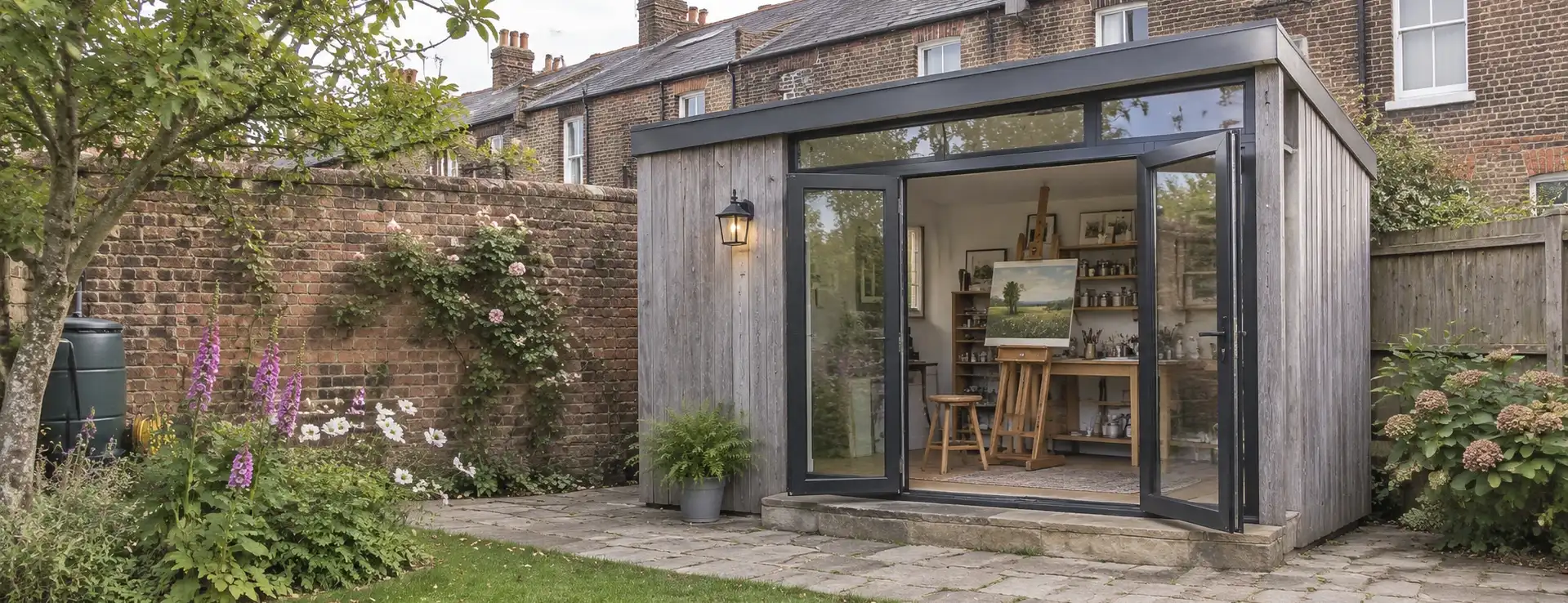
Garden Studios for art, music, therapy and making
A garden studio is an insulated room in your garden set up for one kind of work, such as painting, music, treatment or teaching. We design each one starting from what happens inside and working outwards, for gardens anywhere in Great Britain.
Tell us what the studio is for and where it could go, and we will prepare a quote.
Get a free quoteWhat is a garden studio?
A garden studio is a detached, insulated building in your garden whose light, floor and walls are chosen for one activity rather than for general use. Painting asks for even light and a floor you can wash, while music asks for heavy walls and a sealed door. We settle which comes first before anything is drawn.
- Insulated floor, walls and roof
- Glazing placed for working light
- Sockets at bench height
- Hard-wearing, washable floor
- Clear walls for hanging work
- Heating on a thermostat
How a studio differs from a garden office
A garden office is planned around a desk and a screen. A studio is planned around whatever you make or do, which may call for a sink, a tall wall or a quiet corner. Unlike a summerhouse, it is heated, so work carries on in winter.
How a garden studio is framed and lined
The walls are a timber frame filled with insulation, wrapped in a breather membrane outside and lined with a vapour control layer and boards inside. Timber cladding weathers to silver unless oiled, while composite needs only an occasional wash. The roof is usually a shallow EPDM membrane roof, with room for rooflights where the work needs top light.
Light, walls and floors set up for studio work
Beyond the shell, the working details make it a studio. Daylight is set for the task, long stretches of wall stay blank, and the floor takes paint, clay or chalk without harm. Storage is built in from the start, and the walls cut sound in both directions.
The drawing that comes with your quote shows the bench, the easel or the couch in position, so the working space can be checked before we order anything.
What types of garden studio are there?
Garden studios differ mostly by what goes on inside them, and each use makes its own demands on light, sound, floor and services. Plenty of studios share two uses, such as pottery by day and music practice at night. We build to whichever is harder on the room, so the other fits easily.
Art and craft studio
: North-facing or high-level glass for steady light, a floor that cleans easily and a sink for brushes and clay. The longest wall is kept clear for canvases.Music room
: Heavier walls, laminated glazing and a sealed door to hold practice in, with panels inside to tame echo. Instruments also need an even temperature all year.Therapy or treatment room
: A warm, calm room with space to walk round a couch. Clients arrive by a path of their own and see nothing of the house.Movement or media studio
: A clear, warm floor for yoga or dance, or blackout and extra height for photography and video. Fewer windows, more sockets.
Other uses a garden studio is built for
Beyond the four above, studios serve as sewing rooms, teaching rooms, recording booths and podcast rooms. A recording space needs steady humidity as well as quiet, and a teaching room needs space for a second person. When a use is unusual, we start from its equipment list and plan the room around that.
Sizing a studio from the work done inside
We size a studio from the activity itself. That might be the step back from an easel, a couch with space on both sides or a drum kit with room around it. Wall length for storage and height for lighting come next, all measured inside the insulated walls.
Studio floors and walls matched to the work
Finishes follow the work. Vinyl or sealed timber takes spills, a sprung or cushioned floor suits dance and yoga, and plywood-lined walls hold pins, shelves and hanging rails anywhere. Worktops, cupboards and acoustic panels are fitted after the lining, so they can change later without opening the walls.
Storage is the space people most often undersize. We ask what you will keep in the room as well as what you will do there, and size it for both.
How much does a garden studio cost?
A garden studio typically costs £15,000 to £40,000, and the size of the room decides where in that range it starts. Below are typical prices for three common studio sizes, each a finished room with heating, lighting and power. Sound upgrades and a sink are priced on top.
| Size | Suits | Price range |
|---|---|---|
| 3 × 3 m | Art, craft or therapy | £15,000 to £24,000 |
| 4 × 3 m | Music or teaching | £18,000 to £28,000 |
| 5 × 4 m | Studio with storage | £27,000 to £40,000 |
Typical ranges for a finished studio before any sound upgrades; your quote from us gives the exact figure.
What drives the cost of a garden studio?
Beyond size, sound work moves the figure most, with extra layers of board, laminated glass and a sealed door. Rooflights and large north-facing glazing add cost, as do a sink with its waste run, specialist flooring and a higher-rated supply for a kiln or amplifiers.
Studio extras your quote lists separately
Your quote from us sets the building, its base, the power connection and the interior finish on separate lines. Acoustic upgrades, a sink, specialist flooring and fitted storage appear as options, each with its own price, so you can see what each one adds.
A range is only a starting point. The figure we put in writing after the survey reflects your plot, your access and the work the room has to support.
What are the benefits of a garden studio?
A garden studio gives your work a room that stays set up between sessions, a short walk from the house. These are the gains people mention most once theirs is in use.
Work left out
: The half-finished canvas, the drum kit or the loom stays exactly where you left it, so each session starts with the work, not the setting up.Mess kept outside
: Clay dust, turpentine and offcuts stay in a room with a washable floor, well away from the carpets.Noise away from home
: Practice happens at a distance from bedrooms and from anyone working indoors, behind walls built to hold sound back.Clients kept apart
: Visitors reach the studio by the garden path and never see your kitchen or your family's day.
Studio, spare room or hired space?
Against a spare room, a studio keeps mess, noise and visitors out of the house, though it takes some of the garden and costs more to build. Against hiring a studio by the hour, there is no travel and your set-up stays put, but the cost comes all at once.
Time saved by a studio that stays set up
The real gain is time. There is no unpacking at the start of a session, no packing away at the end, and no booking a hired room around someone else's timetable. People tell us they work more often simply because the room is waiting for them.
A studio earns its place when it is used most weeks. For occasional use we will say so, and a garden office or a room that serves two purposes may fit better.
Do you need planning permission for a garden studio?
In England, usually not: most garden studios at a house fall under permitted development, which allows outbuildings within set limits without an application. The table sets out England's limits that a studio meets most. Scotland and Wales have their own, and we design to whichever apply at your address.
| Rule | Limit |
|---|---|
| Within 2 m of a boundary | 2.5 m overall |
| Overall height | 4 m dual-pitched, 3 m otherwise |
| Use | Incidental to the house |
These are England's limits for a house; the survey shows which of them apply to your plot.
Permitted development for a hobby or work studio
In England these rights apply only to houses, so flats and maisonettes have none, and a studio in a listed building's grounds needs permission. In a conservation area or National Park one beside the house needs it too, and an Article 4 direction or a planning condition can remove the rights. A lawful development certificate gives optional written confirmation.
Does a studio sink bring building regulations?
Building regulations are a separate matter from planning. In England and Wales a detached studio with no sleeping space is normally exempt up to 15 m², or 30 m² if 1 m from every boundary. Scotland uses building warrants with exemptions of its own, and drainage and electrics bring rules in every nation.
Business covenants and listed views near a studio
Some consents sit outside planning altogether. Deeds or a lease may restrict running a business from home, and a studio in view of a listed building or in a conservation area gets a closer look. Protected trees and a public sewer under the plot need agreement too, and we raise all of these at the survey.
Seeing clients or teaching classes in a studio
Working alone on your own art, music or hobby is normally treated as part of living in the house. Regular clients, pupils, group classes, parked cars or noise can amount to a change of use that needs permission, and the council decides each case on its facts. We ask at the design stage who will visit and how often.
Here, how you use the studio matters as much as its size. Let us know about any visitors from the start, and we will explain how the rules apply.
What are the stages of building a garden studio?
We build a garden studio in five stages, from a first look at your garden to a room handed over ready for work. The use of the room is fixed at the design stage, because acoustic layers, pipes and cables all go into the walls before the lining closes them.
- Survey: A visit to your home covers measuring the garden, checking the ground and the route in, and hearing what the studio is for.
- Design: We draw the studio with its light, storage and services placed around your work, then write your quote.
- Groundwork: We prepare the ground, lay the base and run power, and water where needed, across from the house.
- Build: Once the shell is up and glazed, any acoustic layers go in, followed by the electrics, the lining and the finishes.
- Handover: We show you round the finished studio, explain the heating and ventilation, and leave the build records with you.
How long a studio build runs on site
A typical garden studio takes 2 to 4 weeks on site. Before that comes the wait for made-to-order glazing and any approvals, and weather, difficult ground or extra acoustic work can stretch either part.
Siting a studio for light, loads and visitors
The base is chosen at the survey from ground screws, concrete pads or a slab, according to the soil, the slope and nearby trees. A kiln, piano or heavy press calls for a stronger floor. We also weigh which way the glass will face, and whether visitors can reach the door from a side gate.
Studio power for kilns, amplifiers and bench work
The studio gets its own circuit from the house, run through an armoured cable in a trench. Sockets sit at bench height, and a kiln or an amplifier rig gets a dedicated circuit of its own. A data cable in the same trench carries uploads and live streams better than wifi through walls.
If the studio may change use later, say so at the survey. A neutral shell with spare sockets is far easier to plan in at the start than to add afterwards.
How do light and sound work in a garden studio?
A garden studio works well through the year when its light, sound, warmth and air are planned around the work from the first drawing. Each use leans on one of these more than the rest. A painter cares most about light, a musician about sound, and a therapist about a warm, quiet room.
Steady warmth for instruments and artwork in a studio
Insulation in the floor, walls and roof, with double glazing, keeps a studio usable in every month. Steady warmth protects instruments, canvases and paper, and a warm floor suits yoga or treatment. Underfloor heating runs silently for recording, while an air-to-air heat pump also cools on summer afternoons.
How far can a garden studio be soundproofed?
Insulation that keeps heat in does little for sound. Mass, separate layers and sealed gaps reduce it, while doors, glass and vents remain the weak points, and acoustic panels deal with echo inside. Speech and quieter instruments drop a long way, but drums and amplified music are reduced, never silenced.
Extracting paint, solvent and kiln fumes from a studio
Paint, solvents, glazes and a kiln all give off fumes, so the room needs an extract fan as well as windows that open. Trickle vents keep air moving when the door is shut, and gentle background heat in winter holds humidity steady for instruments and stored artwork.
Why studio painters want north light
North light is even and free of glare, which is why painters prize it, and rooflights bring in more from above. South and west glass adds glare and heat that call for blinds. For photography or video we plan blackout, and colour-accurate dimmable lighting carries the work into winter evenings.
The aspect of your garden and the hours you work decide much of this, so we ask about both at the survey and show the answers on the drawing.
Garden studios across England, Scotland and Wales
Soil, slope and the neighbours' windows all affect where a garden studio can go, especially one used for music, and the design allows for each.
- Barking and Dagenham
- Barnet
- Bexley
- Birmingham
- Bradford
- Brent
- Brighton and Hove
- Bristol
- Bromley
- Cardiff
- Coventry
- Croydon
- Derby
- Ealing
- Edinburgh
- Enfield
- Glasgow
- Greenwich
- Hackney
- Haringey
- Harrow
- Havering
- Hillingdon
- Hounslow
- Islington
- Kingston upon Hull
- Lambeth
- Leeds
- Leicester
- Lewisham
- Liverpool
- Luton
- Manchester
- Newcastle upon Tyne
- Newham
- Northampton
- Nottingham
- Plymouth
- Portsmouth
- Redbridge
- Sheffield
- Southampton
- Southwark
- Stoke-on-Trent
- Tower Hamlets
- Waltham Forest
- Wandsworth
- Wolverhampton
Frequently asked questions
Does a garden studio affect council tax or business rates?
For hobby use or your own creative work, usually not. A studio used mainly for a business, especially with visiting clients or pupils, can be assessed for business rates. That decision belongs to the valuation body for your part of the UK, not to us, so we cannot advise on it.
Is a garden studio secure, and does home insurance cover it?
It can have multi-point locks, laminated or toughened glass, outside lighting and an alarm, with blinds keeping instruments, cameras and artwork out of view. Whether a policy covers the building, business equipment or visiting clients varies, so that part is a question for your own insurer.
What upkeep does a garden studio need?
Not much. Clear the roof and gutters, wash or re-oil the cladding by type, and keep a sink's trap free of paint or clay. Check the acoustic door seals now and then, since a worn seal lets sound through, and keep water out of the structure.
Can a garden studio have a toilet, sink or shower?
Yes. A sink for brushes or handwashing is the most common request, and a WC is useful when clients visit. Both need a water feed and a drain connection, by gravity or a small pump, with frost-protected pipes, and the drainage comes under building regulations.
Can you sleep in a garden studio?
Not as built. In England and Wales, sleeping accommodation ends a small building's exemption from building regulations, and Scotland has its own rules, and living in it needs planning permission. Switching between art, music, office or gym use is far simpler.
Can a garden studio take a kiln or a piano?
Yes, if we know at the design stage. We design the floor for the load, and a kiln gets its own higher-rated circuit, clearance from the walls and an extract. A piano needs steady temperature and humidity, and a door wide enough to bring it in.
Is a garden studio private enough for therapy clients?
It can be. We plan a route from the side gate so clients never pass through the house, and use obscured or high-level glass facing the garden. The walls are built to reduce how far voices carry, and a small waiting area and access to a WC complete it.
Get a free quote for a garden studio
A quote for a garden studio starts with the work you will do there and the spot you have in mind. Describe both in the form, or ring us, and we will set up a visit to the garden.
Useful details include the equipment and materials the room must hold, whether clients or pupils will visit, and whether there is a side gate. A few photos of the spot help too.